
high credibility, low trust
the missing layer in the trust equation


the paradox we’ve all felt
we’ve all felt it.
the quiet dissonance of being in the presence of someone, or something, that is clearly competent, impressive even, and yet somehow … not trusted.
nothing is obviously wrong. the credentials check out. the language is right. the performance is polished. and still, something doesn’t settle.
it’s not suspicion.
it’s not disbelief.
it’s a subtle hesitation. a lack of ease.
we trust them to deliver.
we don’t quite trust them to hold.
this shows up everywhere. in leaders. in institutions. in relationships. sometimes, if we’re honest, in ourselves.
it’s the feeling of thinking, i believe you … but i’m not sure i’d follow you into uncertainty.
or, i trust what you know, but i don’t fully trust where you’re coming from.
credibility and trust don’t always travel together.
in fact, some of the most credible people and systems we know are the ones we trust the least. not because they lack intelligence or skill, but because the signal feels thin. managed. slightly off-center.
we don’t always have language for this. we just feel it.
and when we do try to explain it, we often reach for the wrong diagnosis. we assume it’s a failure of communication. or transparency. or consistency. we add more polish. more process. more proof.
but the discomfort remains.
because the fracture isn’t technical.
it’s relational.
and deeper still, it’s internal.
this piece is an exploration of that fracture, of what happens when credibility outpaces coherence. it’s about how trust erodes not through overt failure, but through quiet misalignment.
and of what it might take, now, to rebuild trust from the inside out.
honoring the architect
before we go any further, it helps to name the framework that sits quietly underneath so many conversations about trust.
david maister, charles h. green, and robert m. galford [updated: previously erroneously credited stephen m.r. covey] articulated what has become widely known as the trust equation: trust as a function of credibility, reliability, and intimacy—moderated by self-orientation. simply put, it offered a way to understand why trust grows in some relationships and erodes in others.
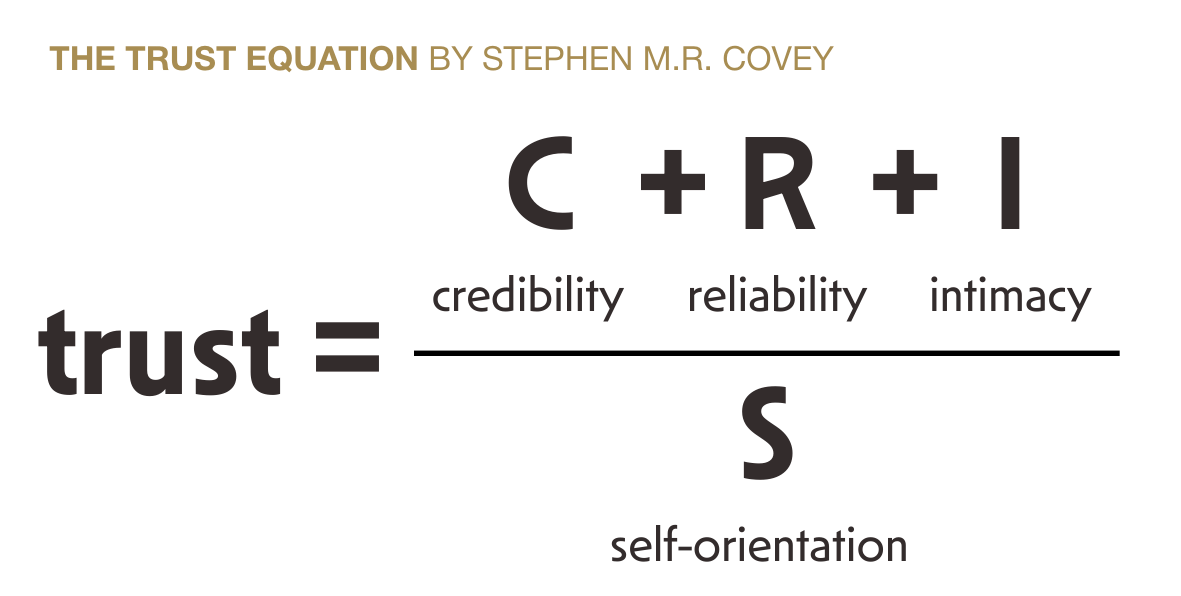
the equation didn’t come from nowhere. covey was responding to a very real gap.
at a time when trust inside organizations was often treated as soft, assumed, or secondary to performance, he made it legible. discussable. operational. he insisted that trust wasn’t just about competence or authority, but about consistency, care, and motive. that alone was a meaningful shift.
and importantly, this was a meso-level framework. the trust equation is fundamentally relational. it evaluates trust as it’s experienced between people—one-to-one, advisor to client, team to team. it wasn’t designed to assess culture, institutions, or systems at scale.
in that context, it worked.
it gave leaders a shared language for something they could feel but struggled to name. it helped teams diagnose breakdowns that had previously been dismissed as personality issues or miscommunication. it offered a way to talk about trust without reducing it to charisma or intent.
covey also gave us two enduring metaphors that still matter: the trust tax and the trust dividend. when trust is low, everything costs more—time, energy, oversight, friction. when trust is high, work moves faster, relationships deepen, and value compounds.
that insight holds.
there’s a generosity in this work. a willingness to translate something deeply human into terms performance-driven systems could recognize. and it’s worth honoring that the trust equation was, in many ways, ahead of its time.
but frameworks, like people, are shaped by the conditions in which they’re born.
they solve for the problems that are most visible in their moment. they carry the assumptions of their era. and they often reveal, quietly, what couldn’t yet be fully named.
the trust equation helped us understand how trust is experienced at the meso level.
it helped us notice when trust was thinning or breaking.
it gave us language for the cost and the upside of trust in motion.
what it didn’t, and perhaps couldn’t, do was ask a deeper question.
not how do others come to trust me?
but what must be true inside me for trust to form at all?
that question sits just beneath the equation. waiting.
what the equation reflects about us
what’s striking about the trust equation isn’t just what it includes—credibility, reliability, intimacy—but what it reveals about the world that produced it.
at its core, it’s an externally referenced model. it asks us to look outward:
how am i being perceived?
how am i landing?
what behaviors increase the likelihood that others will trust me?
that framing didn’t emerge in a vacuum. it mirrors a broader cultural orientation, one many of us were raised within, where meaning, safety, and success are validated externally. where metrics feel more reliable than intuition. where outcomes are easier to point to than origins.
in that world, trust becomes something to manage rather than something to inhabit.
we learn to optimize for reception. to read the room. to calibrate ourselves to context. to adjust tone, posture, even conviction, based on who’s watching. often not out of malice, but out of survival. in complex systems, external validation often feels safer or more accessible than internal truth.
but here’s where the tension tightens.
the more we look outward to determine whether we are trustworthy, the less practiced we become at listening inward.
our attention shifts away from signal and toward response. away from resonance and toward approval. slowly, almost imperceptibly, we lose fluency with ourselves.
and often, that outward turn isn’t accidental. it’s protective.
we’ve been taught, explicitly and implicitly, that turning inward can read as self-centered. that trusting ourselves too much is indulgent. that attunement to self must be carefully rationed, softened, qualified, lest it threaten our standing with others.
so we do the math instead.
how am i being perceived here?
which version of me is safest in this room?
over time, that math becomes a habit.
without being rooted in self, an equation of this nature trains us to be reactive rather than grounded. it teaches us to track response instead of signal. to adjust in real-time instead of a return to center.
reactivity can look like agility. it can even look like emotional intelligence.
but it’s orientation without anchoring. movement without a root.
when trust is built this way, we’re constantly responding to the room, reading cues, recalculating, modulating. not because we’re false, but because we’re unrooted. we don’t trust an internal compass to navigate complexity, so we manage it externally instead.
that’s how we end up many versions of self to many people.
not out of manipulation, but out of survival.
high credibility can coexist with a thinning sense of trust. not because people are insincere, but because the signal they’re emitting is no longer coming from a single center. it’s being calculated in real time. optimized. adjusted.
the outside may look polished.
the inside is working overtime to keep up.
what reads as coherence is often just competence under control.
and this is the paradox hiding in plain sight: an externally driven model of trust can help us succeed within the system, while quietly pulling us further from ourselves.
and when that happens, trust doesn’t break loudly.
it erodes quietly. felt before it’s named.
the layer beneath
if the trust equation helps us understand how trust moves between people, there’s still a quieter question underneath it.
what has to be true inside a person for trust to form at all?
this is the layer most frameworks skip, not because it isn’t essential, but because it’s harder to see, harder to measure, and more complex to operationalize in systems that prefer clarity over complexity.
it’s the micro.
at this level, trust doesn’t begin with behavior.
it begins with alignment.
alignment isn’t agreement. it’s not balance. it’s not optimization.
it’s the ongoing practice of bringing our head, heart, and gut into relationship with one another.
what do i know?
what do i feel?
what do i sense, intuit, or recognize before i can explain it?
when those three are in conversation, something subtle but powerful happens. we become less reactive. less performative. less fragmented.
we stop outsourcing our sense of rightness to the room.
this is where coherence starts.
coherence isn’t polish. it isn’t consistency for show. it’s the felt steadiness that comes from not being at odds with yourself. it’s the quiet experience of knowing that what you’re thinking, what you’re feeling, and how you’re moving aren’t pulling in different directions.
and coherence isn’t loud. it doesn’t announce itself.
but it’s unmistakable.
when coherence is present, congruency becomes possible. who you are on the inside begins to match how you show up on the outside—not perfectly, not performatively, but over time. across contexts. under pressure.
this is where trust actually takes root.
not because you’re trying to be trusted.
but because there’s a single signal moving through you.
without this micro-level coherence, trust work becomes compensatory. we try to manage perception. we rely on technique. we adjust, adapt, and perform reliability in ways that look right but feel effortful.
with coherence, something else happens. trust stops being something we build toward others and becomes something we live from ourselves.
this is why the micro matters.
because without it, the meso compensates.
and with it, trust doesn’t have to be engineered. it can simply emerge.
before going further, it’s worth pausing here.
think of a recent moment when you felt deeply at ease being yourself.
no effort. no second-guessing. just settled.
now, think of a moment when you went elsewhere for answers.
for guidance.
for direction.
maybe even when that choice contradicted what your instincts were quietly signaling.
notice how each moment felt in your body.
the difference between the two is information.
that difference is the signal.
the chain
this is where things begin to clarify.
trust doesn’t appear out of nowhere.
and it doesn’t arrive all at once.
it moves through a sequence, one that’s easy to miss because it’s internal before it’s relational.
it starts with alignment.
alignment is a practice. not a state.
it’s the ongoing work of bringing head, heart, and gut into relationship with one another.
what do i know to be true?
what do i feel drawn toward or away from?
what does my intuition recognize before i can explain it?
when those signals are allowed to speak, and to speak to each other, something shifts. decision-making slows down just enough to become grounded. we stop defaulting to reaction. we begin returning to center.
from alignment, coherence becomes possible.
coherence isn’t perfection. it’s not consistency for show.
it’s the felt experience of not being internally split.
when what we know, what we feel, and how we move are in conversation, there’s less drag. less noise. less need to manage ourselves in motion.
we don’t have to remember which version of us is appropriate for which room.
there’s just us.
from coherence, congruency can take shape.
congruency is what happens when the inside and the outside start to match, over time. across contexts. under pressure. not because we’re trying to be consistent, but because we don’t have to be inconsistent.
who we are doesn’t change dramatically from one situation to the next. the signal holds.
and when congruency is present, trust emerges.
not as something we manufacture.
not as something we chase.
but as a natural response to steadiness.
people sense it before they name it. they feel safe. oriented. able to predict how we’ll show up. not because we’re rigid, but because we’re rooted.
this is why trust can’t be reverse-engineered.
we can perform credibility.
we can rehearse reliability.
we can even simulate intimacy.
but without alignment, coherence, and congruency beneath them, trust remains thin. conditional. effortful.
the chain matters because it’s directional.
alignment → coherence → congruency → trust.
when we try to skip the early links, the later ones wobble.
when we tend to the beginning, trust takes care of itself.
in closing
it’s important to say this plainly.
what we learned wasn’t wrong.
for many of us, especially those navigating systems that weren’t built with us in mind, external calibration was a form of mastery. reading the room. managing perception. optimizing credibility. it kept us safe. it helped us move. it worked.
just like the trust equation worked.
but mastery evolves.
what once protected us can, over time, become constraining. what once helped us navigate complexity can quietly pull us further from ourselves. not because it failed, but because it reached its limit.
and now, we’re being offered a deeper practice.
not a rejection of what we learned.
an expansion.
not an undoing of adaptation.
a reclamation of authorship.
a chance to build an internal compass strong enough to navigate complexity without disappearing inside it.
in the end, it comes down to a question we’re not often taught to ask.
do i trust myself?
before i worry about whether others trust me.
before i optimize credibility.
before i manage reliability or perform intimacy.
because we can fake trust for a while. we can learn the language. hit the marks. say the right things in the right rooms. credibility can be optimized. reliability rehearsed. intimacy simulated.
we can fake trust for a while. but without self-trust underneath it all, the fractures are inevitable.
they show up as exhaustion. as inconsistency. as that subtle sense of being slightly off-center. they show up in our bodies. they show up when pressure hits, and the performance can’t hold.
trust doesn’t fail because we didn’t do enough.
it fails because we skipped the beginning.
trust doesn’t start with being believed.
it starts with being rooted.
and until we’re willing to ask whether we trust ourselves—our knowing, our instincts, our internal compass—everything else is just technique.
polished. impressive.
and ultimately, thin.
Great thinking on trust. Thank you Jen for this valuable content.
*N.B.: The Trust Equation Formula you cite (Trust = (Credibility + Reliability + Intimacy) ÷ Self-orientation that you attribute to Stephen Covey, is in fact the fruit of the work of David Maister, Charles Green and Robert Galford who published it in their book The Trusted Advisor (2000).
I felt this profoundly. “the more we look outward to determine whether we are trustworthy, the less practiced we become at listening inward” is bars. This struck me of the metaphysical, ideological nature of trust! Dope, My Friend!